Golang
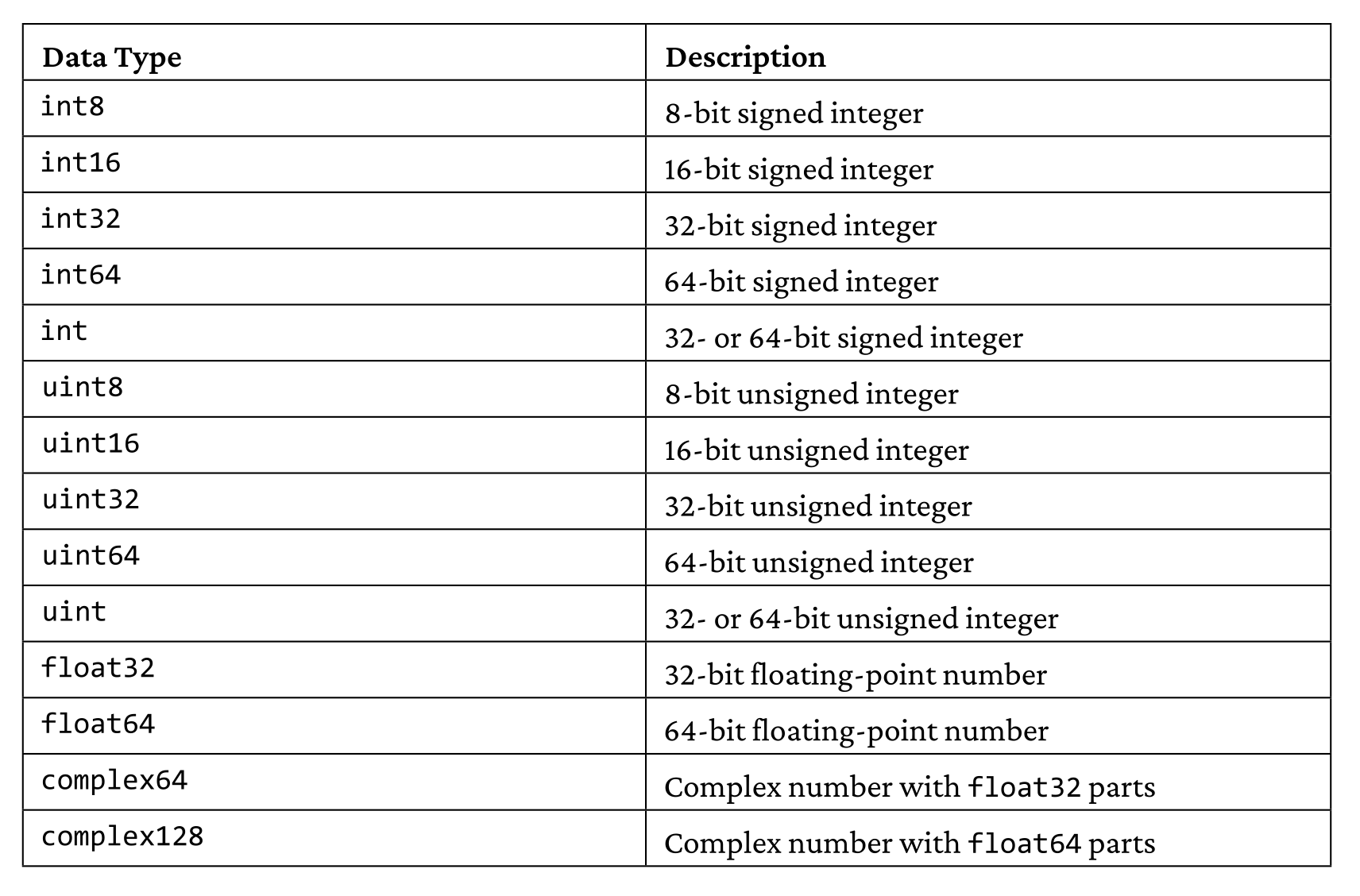
Q) How many different numeric types in Golang?
Go has 15 different numeric types that fall into the three categories: int, float, and complex. That means there are fifteen different ways to describe a number in Go. This includes 11 different integer types, 2 different floating-point types, and 2 different complex number types.
Q) What is defer?
We can delay a function call to the end of the current scope by using the defer keyword. defer tells Go to run a function, but at the end of the current function. This is useful for logging, file writing, and other utilities.
Q) How the pointers are handled?
var pointerForInt *int
In the example above pointerForInt will store the address of a variable that has an int data type. To break it down further, the * operator signifies that this variable will store an address and the int portion means that the address contains an integer value.
In our example, we have our variables: lyrics that has the value of "Moments so dear" and pointerForStr which is a pointer for lyrics. Then we use the * operator on pointerForStr to dereference it and assign a new value of "Journeys to plan". When we check the value of lyrics it’s now "Journeys to plan"!
lyrics := "Moments so dear"
pointerForStr := &lyrics

*pointerForStr = "Journeys to plan"

fmt.Println(lyrics) // Prints: Journeys to plan
Q) How to write while loop in go?
for guess != 56 {
	guess = ask()
}
Q) How to write infinite loop in go?
for {
	count()
}
Q) How to iterate over an array?
letters := []string{"A", "B", "C", "D"}
for index, value := range letters {
  fmt.Println("Index:", index, "Value:", value)
}
Q) How to iterate over key and value in map data structure?
addressBook := map[string]string{
  "John": "12 Main St",
  "Janet": "56 Pleasant St",
  "Jordan": "88 Liberty Ln",
}
for key, value := range addressBook {
  fmt.Println("Name:", key, "Address:", value)
}
Q) What is the difference between slices and arrays in Go?
Arrays have fixed size, whereas slices have ability to change their size.
arr := [4]int{3,1,4,3}sl := []intNotice that we did not specify the length of slice variable.
When we create a slice variable using the array variable:
sl := arr[:] slice variable also points to the same address that arr points to. So, when we update a variable by using sl[2] = 2 arr variable also gets updated.
Q) How cap differs from len?
// cap usage in slices
slice := []string{"Fido", "Fifi", "FruFru"}
// The slice begins at length 3 and capacity 3
fmt.Println(slice, len(slice), cap(slice))
// [Fido Fifi FruFru] 3 3
slice = append(slice, "FroFro")
// After appending an element when the slice is at capacity
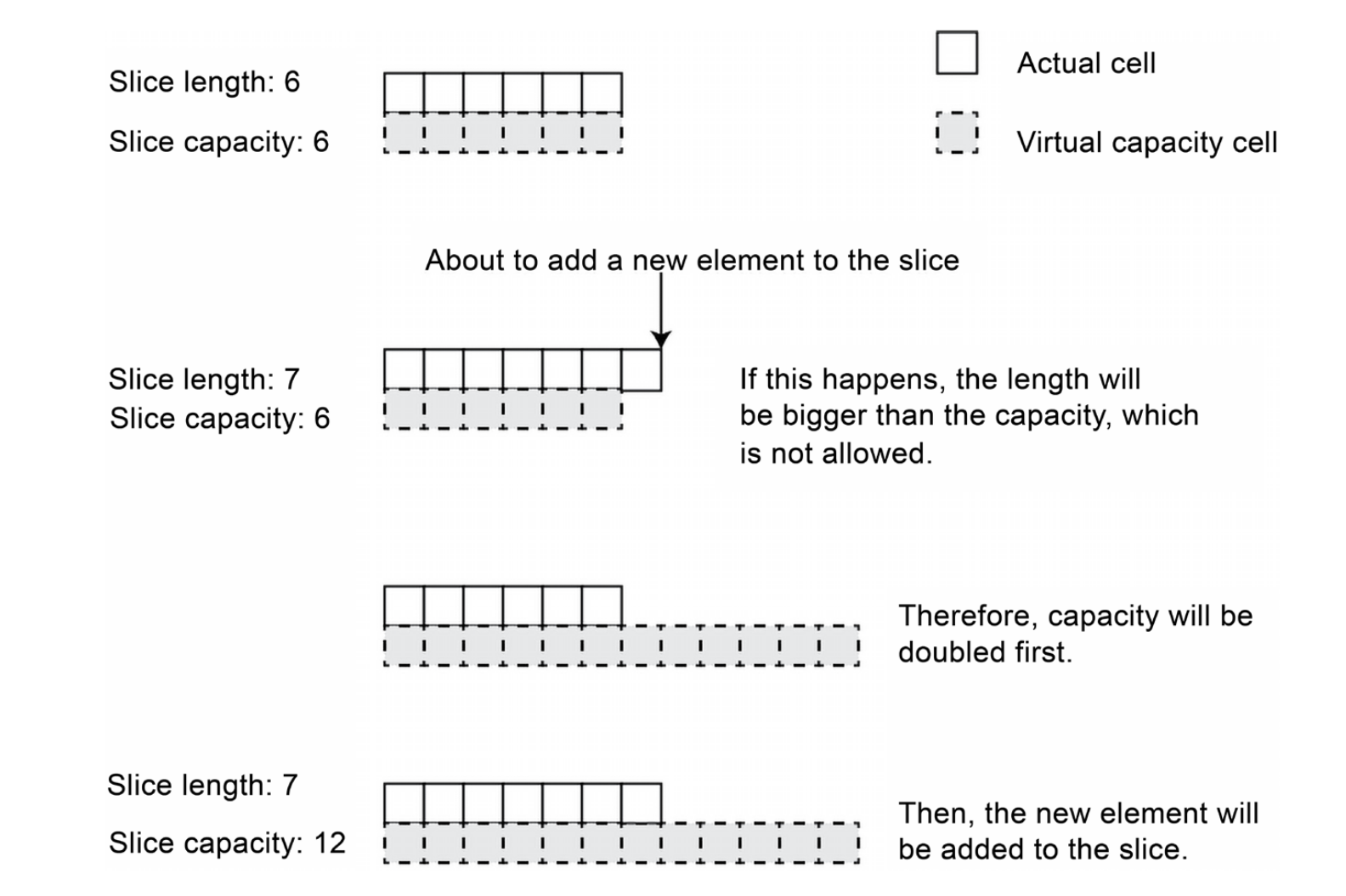
// The slice will double in capacity, but increase its length by 1
fmt.Println(slice, len(slice), cap(slice))
// [Fido Fifi FruFru FroFro] 4 6
Q) How pass by value and pass by reference is handled for arrays?
// When we pass arrays to functions, their values do not change since it is pass by value. However, with slices, we can update the values.
package main

import "fmt"

func main() {

	myTutors := [4]string{"Kirsty", "Mishell", "Jose", "Neil"}

	myTutorsButSlice := myTutors[:]

	modifiedSlice := changeLastElement(myTutorsButSlice, "Bobby")

	fmt.Println("Arr:", myTutors)

	fmt.Println("Slice:", modifiedSlice)

	/*

	Arr: [Kirsty Mishell Jose Bobby]

	Slice: [Kirsty Mishell Jose Bobby]

	*/

}

func changeLastElement(inputSlice []string, inputString string) []string {

inputSlice[len(inputSlice)-1] = inputString

return inputSlice

}
Q) How does map operations look like?
// Create empty map (when we do not know the content of the map yet)
defaultMap := make(map[string]float32)

// Create a map with known values
donuts := map[string]int{
	"frosted": 10,
	"chocolate": 15,
	"jelly": 8,
}

// To access value of a key
firstChoice := donuts["frosted"]

// Status has value of false if donuts map does not contain bavarian cream
secondChoice, status := donuts["bavarian cream"]

// Update add key-values
donuts["glazed"] = 12 // If there is "glazed" then it is value will be 12
// If not then it will be added to the map

// Delete key-value pair
delete(donuts,"chocolate")
Q) How does struct definition look like?
// Define struct
type Pet struct {
	name string
	petType string
	age int
}

// Initialize a struct
nuggets := Pet{"Nuggets", "dog", 4}
**Q) What are practices for pointers?
// Pointers Recap

// Defining a string variable called 'val'
val := "Tuna"

//valPtr becomes a string pointer that holds the address of 'val'
valPtr := &val // valPtr becomes -var valPtr *string

fmt.Printf("Type of valPtr is: %T", valPtr) // *string
fmt.Println()

// Printing the value stored in variable 'val'
fmt.Println(val) // Tuna

// Printing the address of 'val' variable
fmt.Println(valPtr) // 0xc000014070

// Dereferencing, valPtr was a pointer, and when we use '*', it refers to value stored in variable 'val'
fmt.Println(*valPtr) // Tuna

// The address of 'val' variable
fmt.Println(&val) // 0xc000014070
Q) How to build and run code written in Go?
# Build go code.
# If no source files are provided, go build looks for a main package in the current directory.
go build -o HelloWorld hw.go

# This also compiles the code, generates en executable file, executes it and deletes it once it's been run.
go run hw.go
Q) When to use go run and go build?
Using go run is a better choice when testing code. However, if you want to create and distribute an executable binary, then go build is the way to go.
Q) What are the best practices for reading user input?
The fmt.Scanln() function is rarely used to get user input. Usually, user input is
read from command line arguments (os.Args) or external files. However, interactive command line applications need fmt.Scanln().
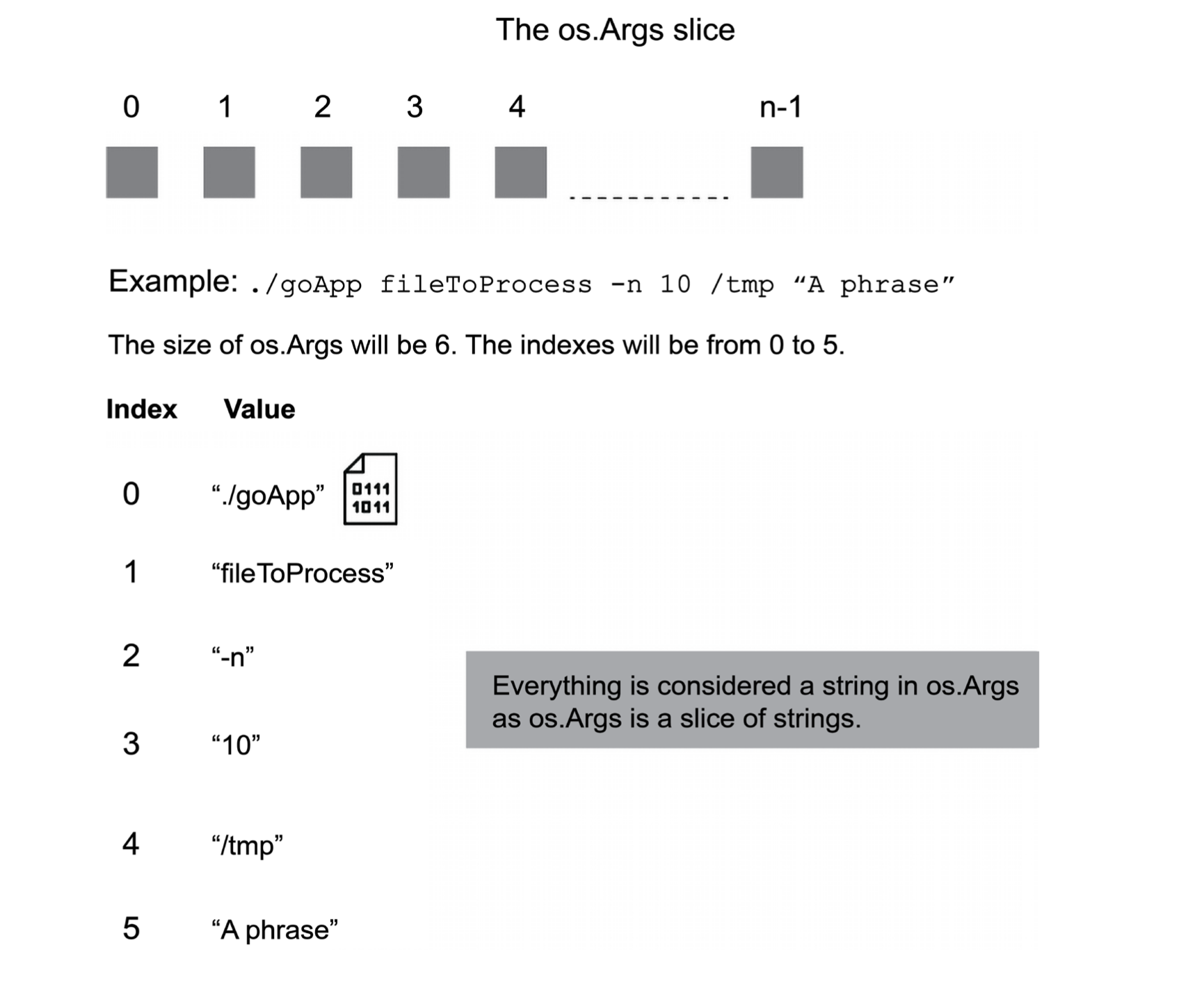
Q) How does os.Args slice is indexed?
// %v stands for value, meaning that it would print out the value no matter what the type is, could be int, string, bool etc.
// Useful when we do not know what will be returned.
// Example:
// Reports if the second input is the prefix of the first input
fmt.Printf("Prefix: %T, %v\n", strings.HasPrefix("Tuna", "un"), strings.HasPrefix("Tuna", "un")) // bool, false
Q) What’s rune?
In Go, rune is an alias for int32, which means it is a 32-bit integer used to represent Unicode code points.
Q) How const variables differ from standard variables?
const variables are getting their values during the compile time. This can be expressed like the following:
const PI = 3.14
Gets converted into:
MOVSD xmmm0, 3.14
Since the value of PI will remain the same throughout the execution, the value of its are already known at compilation.
However, variables in Go are getting their values during program execution. Because, a value of a variable might depend on a return value of a function, thus we need to execute the program to find out its actual value.
func foo(x int) int {
	return 2 * x
}

func main() {
	y := foo(4) // I do not know the value of y until the program gets executed
}
Q) How to define arrays without known size?
- When defining an array variable, you must define its size. Otherwise, you should put
[…] in the array declaration and let the Go compiler find out the length for you. So you
can create an array with 4 string elements either as:
[4]string{"Zero", "One", "Two","Three"}or[...]string{"Zero", "One", "Two", "Three"}. If you put nothing in the square brackets, then a slice is going to be created instead. As it contains four elements, the (valid) indexes for that array are 0, 1, 2, and 3.
- You cannot change the size of an array after you have created it.
Q) How does the slice header value look like?
A slice value is a header that contains a pointer to an underlying array where the elements are actually stored, the length of the array, and its capacity.
type SliceHeader struct {
	Data uintptr // pointer to the underlying array
	 // (a slice is implemented using an underlying array)
	Len int // length
	Cap int // capacity
}
Q) How the slice length and capacity gets altered?
Q) How to represent single characters in Go?
As Go does not have a data type for storing single characters, it uses byte and rune for
storing character values. A single byte can store a single ASCII character only whereas
a rune can store Unicode characters. As a result, a rune can occupy multiple bytes.
rune is an alias for int32, whereas byte is an alias for uint8. So, a rune can contain ascii characters as well as unicode characters.
[]byte: Use when working with ASCII text, binary data, or when performance and memory usage are concerns (sincebyteis more compact).[]rune: Use when dealing with text that may include non-ASCII characters, such as characters from different languages or special symbols, becauserunecan represent any Unicode character.- If you only need to handle simple English text,
[]byteis sufficient. - For internationalization or dealing with diverse character sets,
[]runeis necessary.
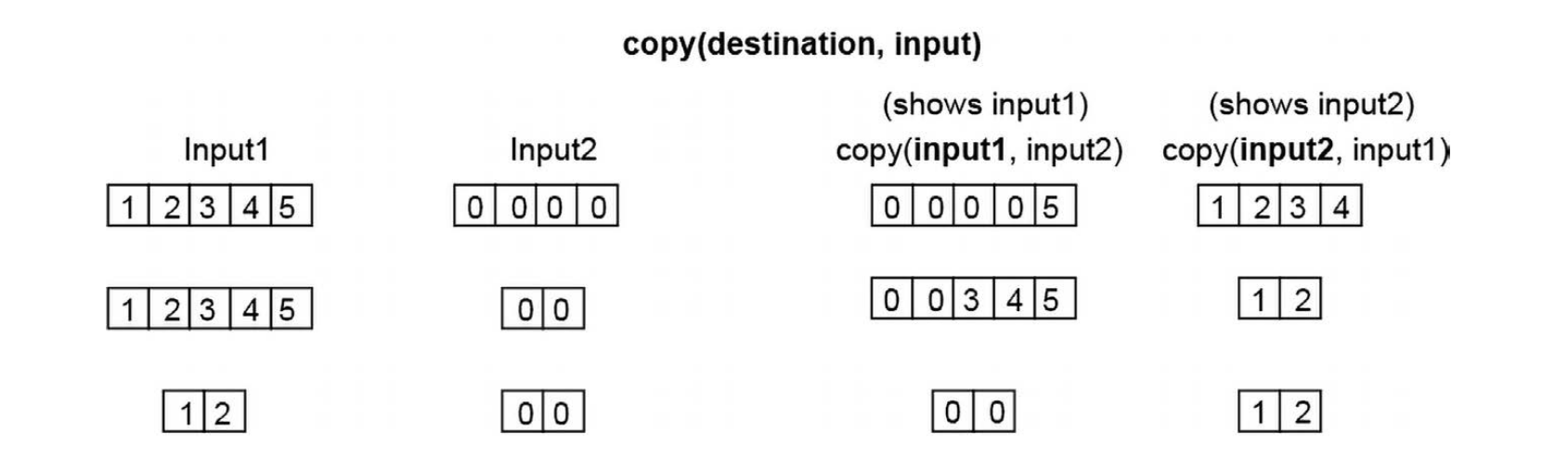
Q) How doess copy function work?
Q) How slices are passed to functions?
Slices are passed to functions without the need to use a pointer — it is Go that passes the pointer to the underlying array of a slice and there is no way to change that behavior.
Q) When to use map instead of array or slice?
The general idea is that if an array or a slice cannot do the job, you might need to look at maps. If a map cannot help you store your data the way you want, then you should consider creating and using a structure.
Q) How to use regex expressions in Go?
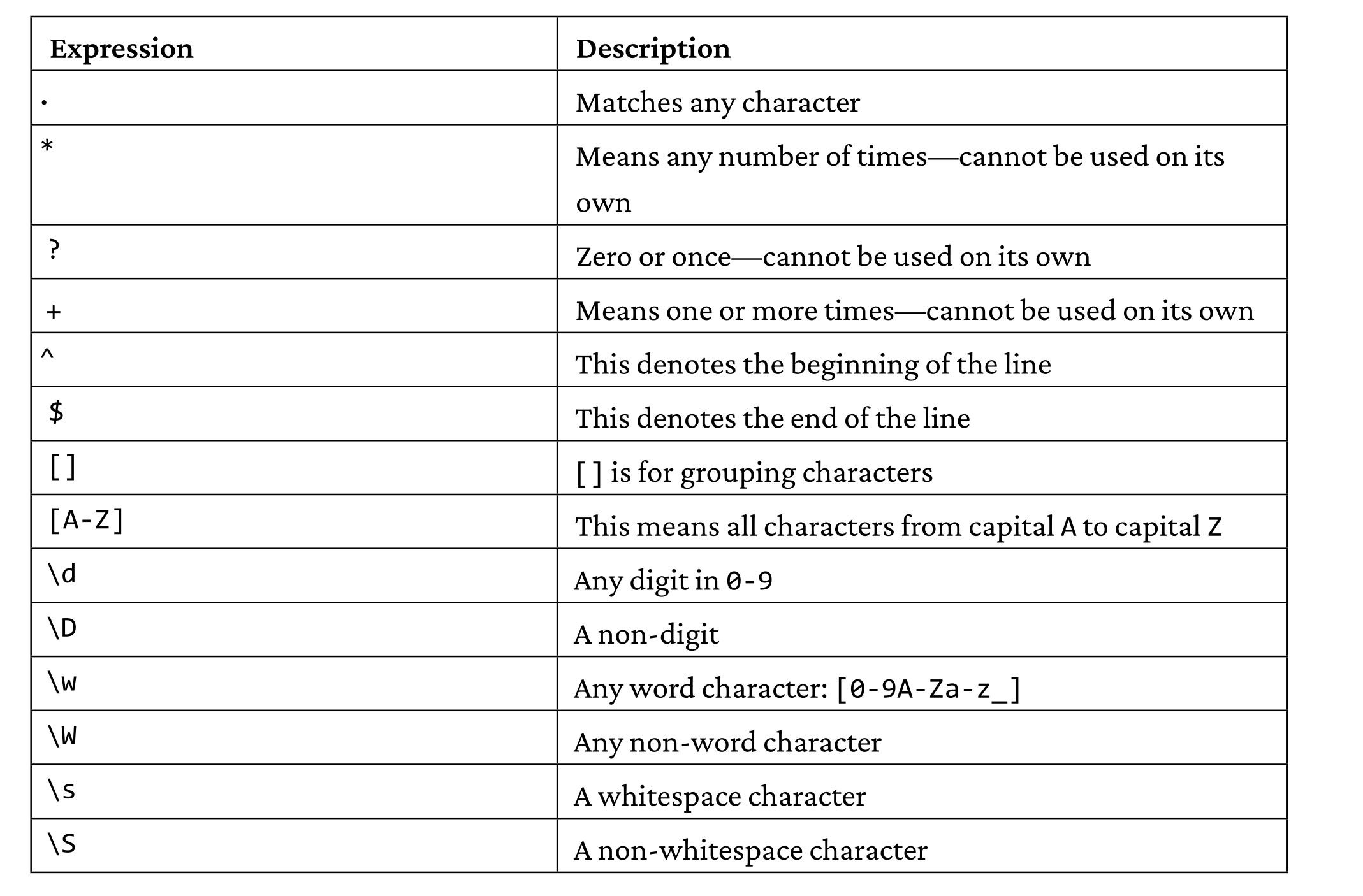 Characters presented in the table are used for constructing and defining the grammar of a regular expression.
Q) What is Generic Programming in Go?
Generic programming is a programming paradigm that allows the developer to implement a function using one or more data types that are going to be provided at a later time.
Generics is a feature that allows you the capability of not precisely specifying the data type of one or more function parameters, mainly because you want to make your functions as universal as possible.
When you see list[T any], you should not think about arrays or slices, even though the syntax looks similar to defining slices or arrays.
Differences:
Slices/Arrays:
- In Go, you define slices or arrays like this:
[]T(slice of typeT) or[N]T(array of typeTwith lengthN). - These are built-in, contiguous memory structures that allow indexed access to elements.
- In Go, you define slices or arrays like this:
Generic Structs (like
list[T any]):- Here,
list[T any]is a generic type whereTis a placeholder for any type. Theanyconstraint means thatTcan be of any type. - It’s not an array or a slice. In your example,
list[T any]is a custom data structure (a linked list) where nodes are connected through pointers (next), not stored contiguously in memory like slices/arrays.
- Here,
Think of it this way:
- Arrays/Slices = Contiguous blocks of memory, accessed via indices.
- Custom List (
list[T]in your case) = A chain of elements (nodes), each pointing to the next, accessed via traversal.
They share the [T] syntax for generics and arrays, but conceptually they represent different structures.
Q) How does Polymorphism look like in Go?
// An example for polymorphism in golang
// drawShape function does not care what the shape is, it only accepts a shape,
// and based on the type of shape, correct draw() function is implemented
type Shape interface {
    Draw()
}

type Circle struct{}
type Square struct{}

func (c Circle) Draw() {
    fmt.Println("Drawing a circle")
}

func (s Square) Draw() {
    fmt.Println("Drawing a square")
}

func drawShape(s Shape) {
    s.Draw()
}

func main() {
    c := Circle{}
    s := Square{}

    drawShape(c) // Output: Drawing a circle
    drawShape(s) // Output: Drawing a square
}
Q) What are the differences between package and module in Go?
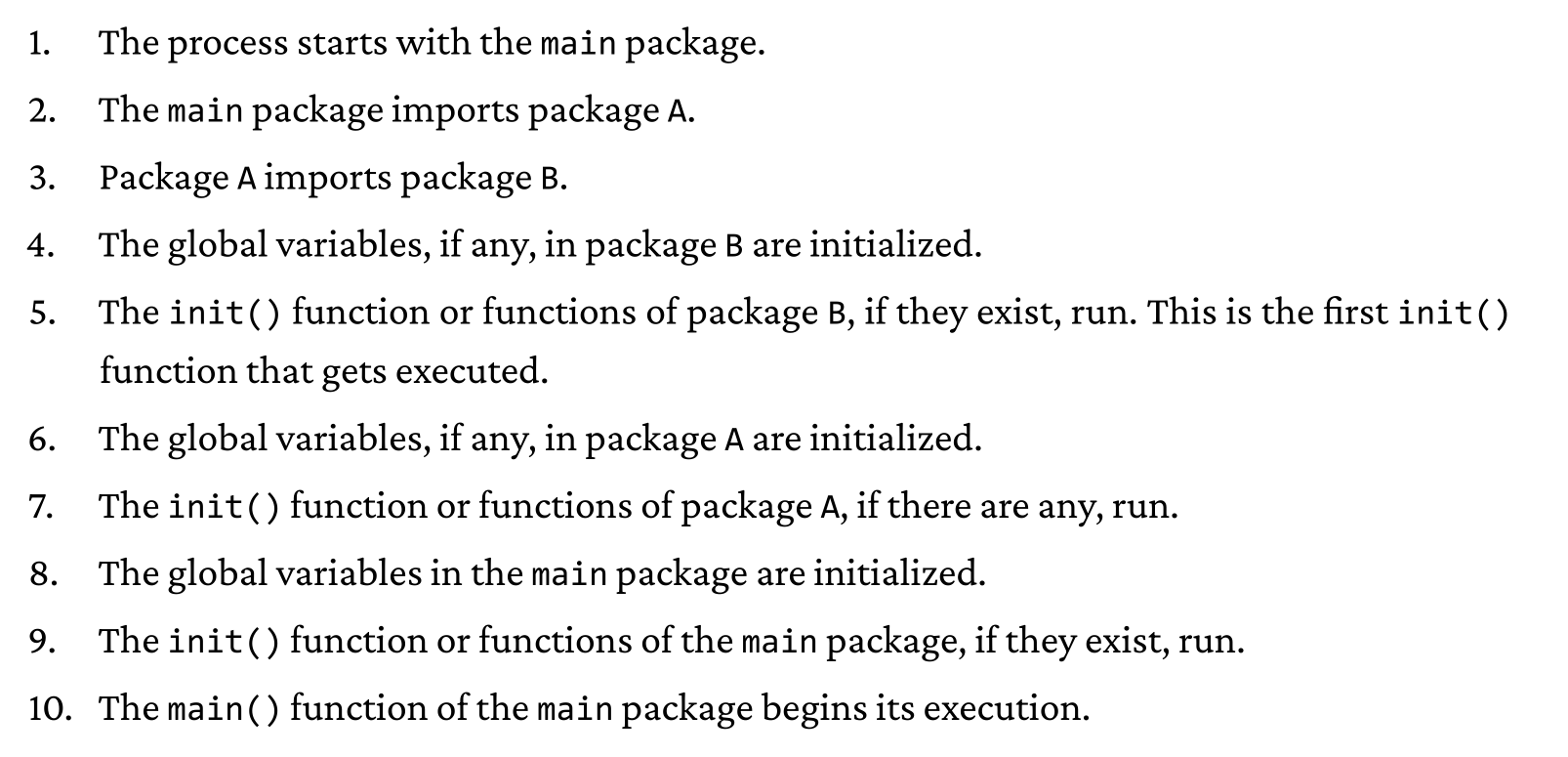
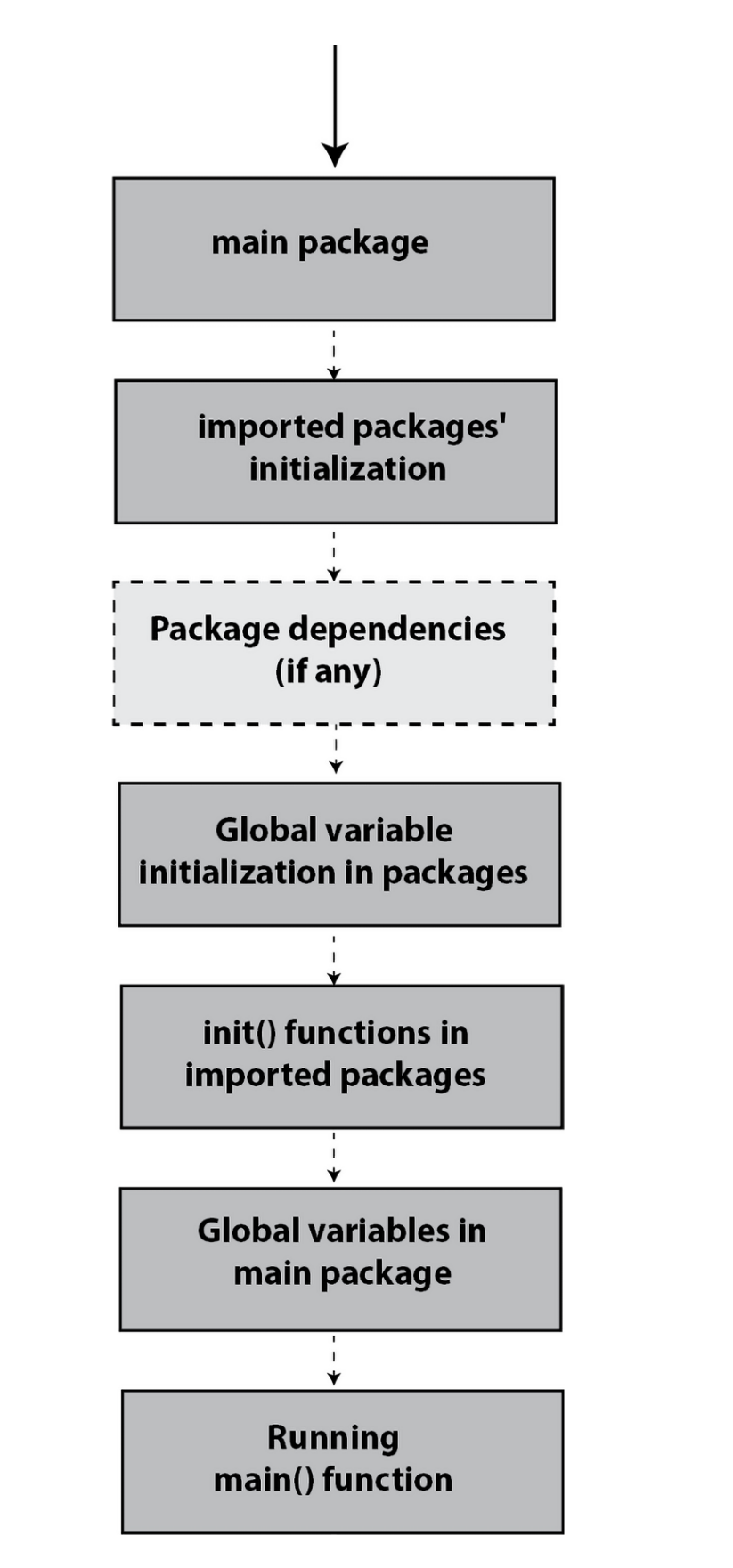
Packages are the way of organizing, delivering, and using code. Modules are collections of packages. So, A module is a collection of packages, while a package is a collection of files.
Q) What’s GO111MODULE environment variable?
GO111MODULE environment variable controls the behavior of whether to check the go.mod and go.sum files. If we set it to on, go compiler will look for the go.mod and go.sum files for dependencies. The default value is auto, which means that if there’s a go.mod file there, it will look at it, if not, it will look at GOPATH value which is ~/go/src.
–
Q) What are the ways of accessing standard files in Go?
Go uses os.Stdin to access standard input, os.Stdout to access standard output, and os.Stderr to access standard error.
Q) What’s marshaling and unmarshaling in Go?
Marshaling is the process of converting a Go structure into a JSON record. You usually want that for transferring JSON data via computer networks or for saving it on disk. Unmarshaling is the process of converting a JSON record given as a byte slice into a Go structure. You usually want that when receiving JSON data via computer networks or when loading JSON data from disk files.
The number one bug when converting JSON records into Go structures, and vice versa, is not making the required fields of your Go structures exported, that is having their first letter in uppercase. When you have issues with marshaling and unmarshaling, begin your debugging process from there.
Q) What’s the difference between any interface{} in Go?
In Go, the key difference between any and interface{} is semantics, not functionality. Both are effectively the same and are interchangeable, as any is just an alias for interface{} introduced in Go 1.18 to improve readability and align with modern usage.
Use any for readability in newer Go code. Stick with interface{} if maintaining legacy code for consistency.
Q) What happens under the hood, once we run go mod init and go mod tidy?
When we run go mod init, the go.mod file gets created, and once we run go mod tidy, the packages that are stated under import part of the code gets downloaded, and they are put into ~/go/pkg/mod/github.com/spf13 for viper package, for instance.
In the background, what I observe that happens is that the go mod tidy command downloads the packages mentioned in the code, just like running go install github.com/spf13/viper.
Q) How does cobra-cli differ from other modules?
Because cobra-cli is rather than a framework that allows you to create command line interface, we use commands like cobra-cli init and cobra-cli add, to build the CLI.